
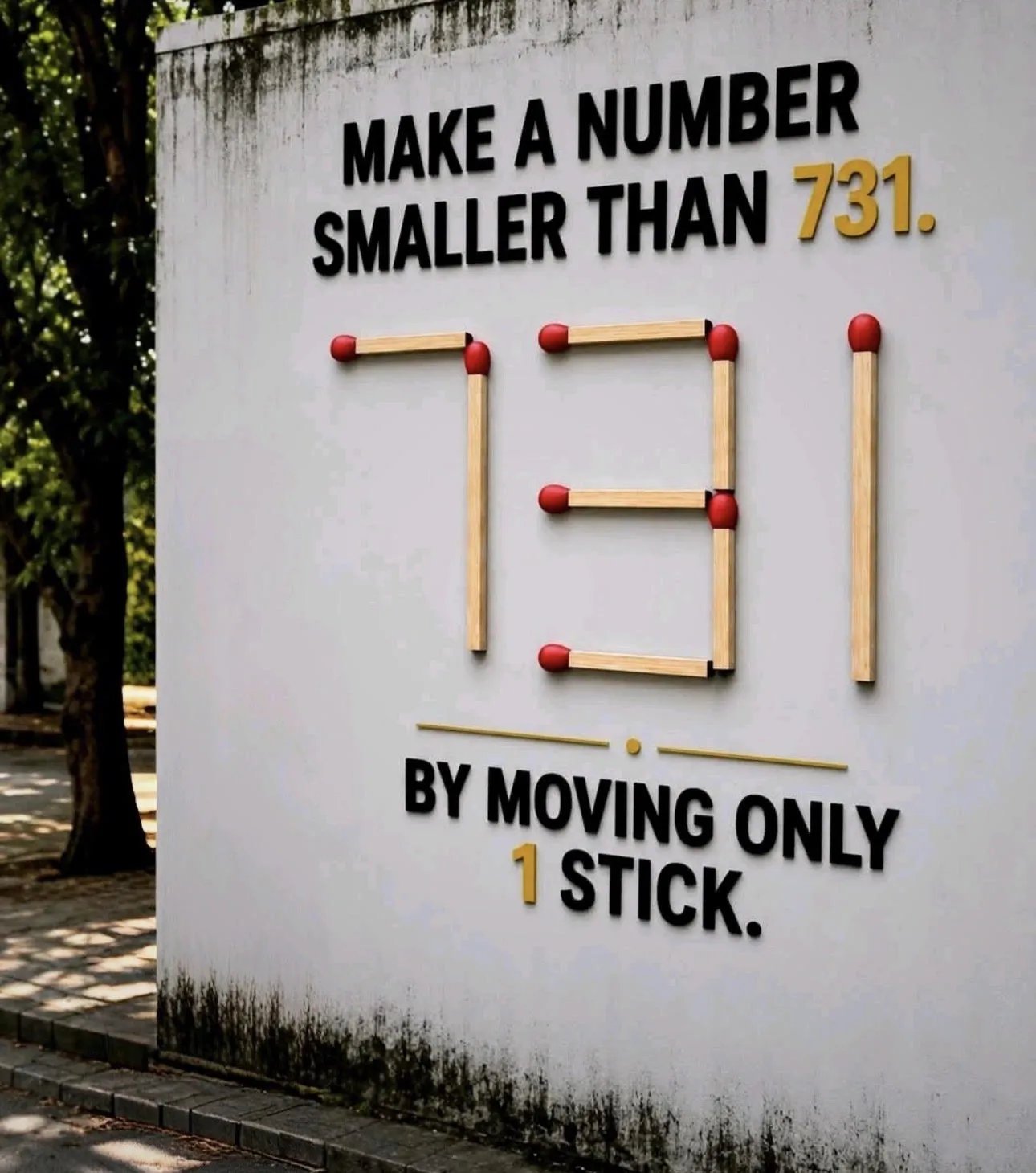
Matchstick puzzles have fascinated people for decades because they test something more than mathematical ability they challenge the way we think. One of the most popular brain teasers is:
“Make the number 731 smaller than 731 by moving only one matchstick.”
At first glance, it seems impossible. After all, how can moving just one matchstick reduce the value of the number? The secret lies in thinking beyond conventional arithmetic.
Why Are Matchstick Puzzles So Popular?
These puzzles encourage creative thinking, improve problem-solving skills, and help develop cognitive flexibility. Instead of searching for complicated calculations, the goal is to look at the digits from a different perspective.
The number 731 is usually represented using matchsticks in a seven-segment style. By moving a single stick, one or more digits can be transformed into another valid digit.
Possible Solutions
Depending on how the number is arranged, there can be more than one correct answer.
Solution 1: Turn 7 into 1
If the digit 7 is made with three matchsticks, moving one stick can sometimes convert it into 1.
731 → 131
Since 131 is less than 731, the puzzle is solved.
Solution 2: Turn 3 into 2
In certain matchstick layouts, moving one matchstick changes the digit 3 into 2.
731 → 721
Because 721 is smaller than 731, this is also a valid solution.
Solution 3: Turn 7 into Another Smaller Digit
Some versions of the puzzle use a different matchstick arrangement where moving one stick from 7 creates another valid digit, producing a number smaller than 731.
The exact answer depends on the matchstick pattern used in the puzzle.
Why Do Different Answers Exist?
Unlike standard mathematical questions, matchstick puzzles are based on visual arrangements rather than fixed rules. Different books, websites, and puzzle creators may draw the digits differently.
As a result:
- More than one answer may be correct.
- The “right” solution depends on the original matchstick layout.
- Always examine how each digit is constructed before deciding your answer.
What Does This Puzzle Teach Us?
The real purpose of this puzzle is not finding a single answer but learning to think creatively. It reminds us that many problems can have multiple valid solutions when viewed from a different angle.
This type of lateral thinking is useful not only for puzzles but also for decision-making, innovation, and everyday problem-solving.
Final Thoughts
We at Mentoring Minds Counsellors understand that The puzzle “Make a number less than 731 by moving only one matchstick” is a perfect example of how a simple challenge can stretch our imagination. Whether your answer is 131, 721, or another valid number based on the matchstick arrangement, the important part is understanding the logic behind the transformation.
Sometimes, moving just one small piece is enough to completely change the outcome a lesson that applies to puzzles and life alike.
Answer: The most commonly accepted solutions are 131 and 721, depending on the original matchstick arrangement.
Leave a Comment